 NERVE
NERVEHow to Improve Your Reaction Time
A light turns green. A ball comes in faster than you expected. A notification pops up at the exact wrong moment. Between the signal and your move, something happens that you do not really control: your reaction time. And you tend to think that fraction of a second is fixed. It is not. You can improve it, measure it, and watch it drop. Not with a magic pill, but with dumb, steady practice.
Let us start with the only thing that matters: an honest number. The average human reaction time to a visual signal hovers around 250 milliseconds, roughly a quarter of a second between the moment the eye sees and the moment the finger moves. That sounds fast. It is actually an eternity for your brain, and there is plenty of room to trim.
So what counts as a good reaction time?
Studies on simple reaction time give a fairly stable range for a healthy adult: between 250 and 300 ms on visual cues. Dropping below 200 ms is already quick. Players who train regularly often reach 150 to 180 ms. That is not superhero genetics, it is repetition.
A detail few people know: the channel matters. Your brain reacts faster to sound (around 170 ms) and to touch (around 150 ms) than to images. The auditory signal takes a shorter processing path than the visual one. In other words, reacting to a beep is easier than reacting to a flash. Keep that in mind, we come back to it below.
You can test yourself in thirty seconds on a tool like Human Benchmark or a dedicated reaction time test. Run several attempts, keep the average. A single run means nothing: the variability between two clicks is huge.
Why your reflexes let you down
Before chasing milliseconds, stop bleeding them for no reason. Three silent thieves:
- Lack of sleep. A single bad night can slow you down by around 50 ms. That is enormous: it drags you from a decent score to a zombie score. No amount of training makes up for sleep debt.
- Age. Reaction time peaks in the early twenties, then slowly degrades. It is not a death sentence, but it is a fact: at 40 you start with a slight handicap that training claws back.
- Distraction. A brain juggling ten things reacts badly. Multitasking is the enemy of reflex. One task, one wait, one reaction.
A small measurable bonus: caffeine cuts reaction time by about 10 ms. Nothing spectacular, but real. A coffee has never turned anyone into a machine, it just recovers a little slack.
Reflex is not a gift. It is a neural pathway you reinforce by walking it over and over.
How to train your reaction speed
Here is the good news, the one that justifies this article: reaction time is trainable. Training studies show gains of 10 to 20 percent within a few weeks of regular practice. In concrete terms, a beginner sitting at 280 ms can aim for 220 ms, sometimes less. It is not the muscle getting faster, it is the neural route between perception and action being reinforced through repetition.
What works, tested and documented:
- Coordination. Throwing and catching a ball, juggling, playing table tennis. Rhythmic exercises that force eye and hand to sync up are a proven way to speed up reflexes.
- Varied stimuli. Reacting sometimes to a visual cue, sometimes to sound, sometimes to touch. The brain learns to process each channel faster when you hit it on multiple fronts.
- Consistency over intensity. Five minutes a day beats an hour once a week. Neural plasticity loves frequency, not marathons.
- Measurement. What does not get measured does not improve. Log your score, compare week over week. Invisible progress kills motivation.
The common thread through all of this: you have to put yourself in a position to react fast, often, to something unpredictable. An exercise where you know what is coming does not train reflex, it trains anticipation. Those are two different things.
Why reflex games are the best training ground
You can juggle in your living room. Or you can open a game that throws an unpredictable signal at you every two seconds and punishes the slightest millisecond of delay. Reflex games tick every box of effective training: varied stimuli, unpredictability, short loop, instant feedback, measurable score. And above all, they make repetition bearable, because it is a game and not a physio drill.
There is a reason these "rage" games are so gripping. Every failure hands you a precise piece of information (you reacted too late, you anticipated at the wrong moment) and an immediate itch to try again. That short loop is exactly the mechanism that reinforces a neural pathway: act, result, correct, go again. The brain loves it. Your ego, a little less.
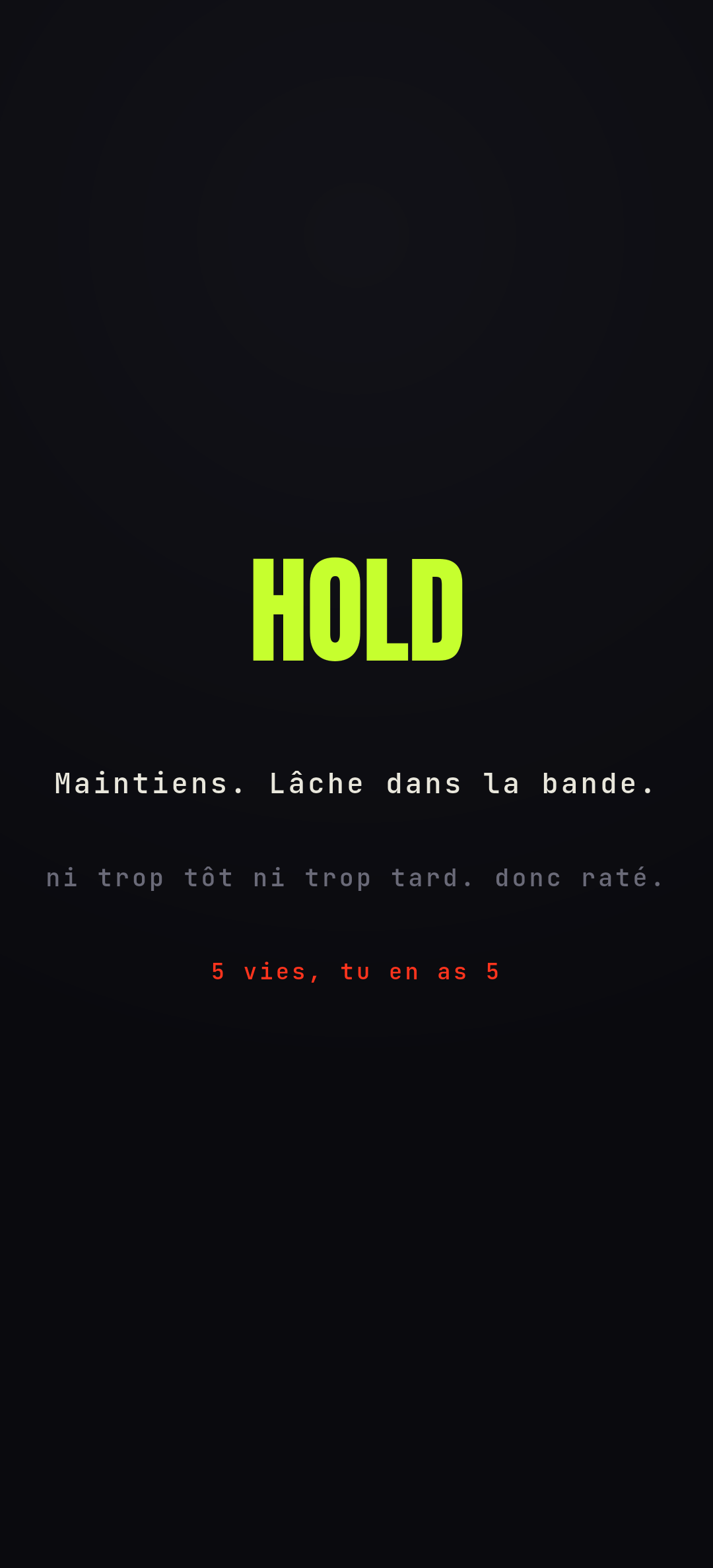
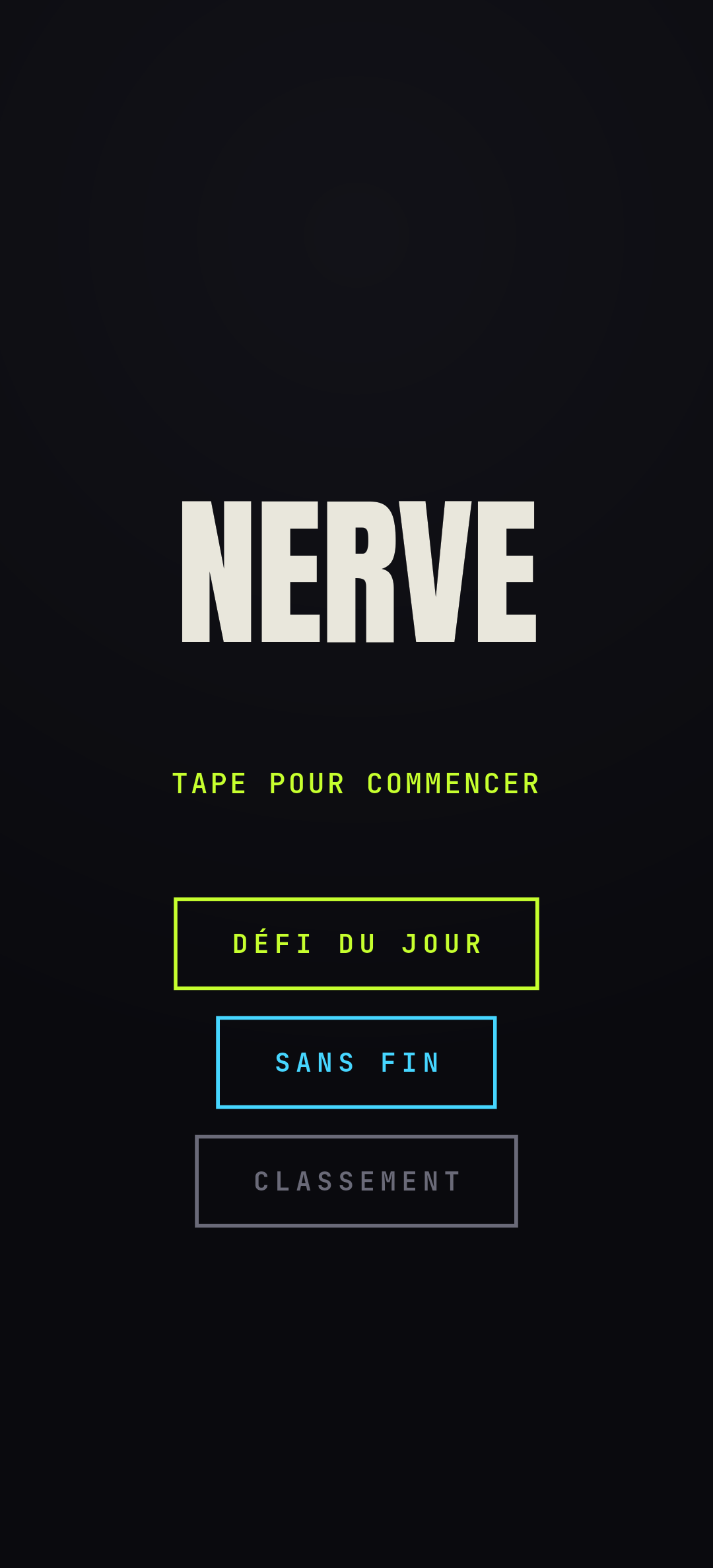
That is precisely the terrain of NERVE: a chain of 20 reflex mini-games that drop on you without warning. Block, hold, dodge, memorize, react. Each success makes the next one harder, each failure costs one of your five shared lives and throws you into another game. You anticipate nothing, you react to everything. It is brutal, it is short, and it is exactly the kind of varied repetition your reaction time needs to come down.
The daily challenge is the same for every player, which gives you an honest point of comparison week over week, and a score card to share so you can humiliate your friends (or get humiliated). The global leaderboard handles the rest. If you want to measure your reflexes rather than tell yourself you are fast, it is a solid test bench. Then all that is left is to take a look at what NERVE offers and see how long you last.
Test your reflexes for real
20 mini-games, five shared lives, a difficulty that climbs with every success. The machine wants you to fail. How long can you hold?
So where do you start?
Three steps, no more. Measure your current reaction time to get an honest baseline. Sleep properly, because 50 ms of sleep is worth more than any training session. Then repeat, often, on unpredictable signals, five minutes a day. In two to three weeks, you will watch your number move. Not because you became someone else, but because reflex is a skill, and skills get trained.
The real question is not whether you can improve. You can. It is how long you will last against a machine that speeds up every single time you succeed. That, there is only one way to find out.