 NERVE
NERVESimple vs choice reaction time: which one matters?
The screen turns green. You click. A number appears, and your ego immediately starts looking for the screenshot button. That test measures simple reaction time perfectly well. It does not tell you whether you will press the correct control when a new shape lands in the middle of a run. Now you must detect, understand, and act. That is choice reaction time, the part that can turn a proud millisecond merchant into a startled pigeon.
Both measurements matter. They just answer different questions. If you want better reactions in a game, comparing your single best click with a stranger's number is not enough. You need to know which stage is slow: seeing the cue, choosing a response, or carrying out the movement.
What is simple reaction time?
A simple reaction task has one instruction: when the signal appears, perform the one response you already know. Think of a sprint start, a beep paired with a button, or a red screen turning green. You know the stimulus and the action before the trial begins. The only real uncertainty is when it will happen.
This setup isolates detection and movement initiation reasonably well. It is useful for checking your state today, comparing repeated sessions on the same device, or noticing the damage after a dreadful night of sleep. Our guide on how to test your reflexes without rigging the result covers the practical details: take several trials, use the median, keep the same display, and do not let your finger fall before the cue.
Trouble starts when people turn that number into a universal reflex grade. A simple task contains no wrong key. Your brain has nothing to sort out. It waits and fires. That is a real skill, but it is a narrow one.
One possible signal and one known response. The main question is when to move.
Several signals and responses. You must decide what to do before moving.
What is choice reaction time?
In a choice task, each stimulus demands a different response. Red means left, blue means right. An arrow could require a swipe, a symbol a long press, and a trap no movement at all. The clock now contains perception, identification, response selection, and execution.
This distinction reaches back to the early days of mental chronometry. In the nineteenth century, Dutch physiologist Franciscus Donders compared tasks with different levels of complexity to estimate the time occupied by mental operations. The subtraction sounded wonderfully neat: time with a decision minus simple time equals decision time. A living brain is less cooperative than a spreadsheet, but the experiment established a distinction researchers still use.
Choice reaction looks much more like play. Games rarely ask you to hit the same control whenever the same green flash appears. They also ask you not to press when a cue is a decoy. That inhibition matters. A lightning-fast wrong answer is still wrong, however impressive the timer looks.
Why do more choices slow your reaction time?
In 1952, British psychologist W. E. Hick tested tasks with as many as ten alternatives. His original paper on information gain connected response delay with the amount of uncertainty a participant had to resolve. The relationship is not “twice as many buttons, twice as slow.” It is approximately logarithmic: each doubling of the alternatives adds a similar amount of decision load.
Hick estimated an average rate of roughly five bits per second within his particular perceptual-motor setup. That historical figure is not a universal brain speed for your profile bio. The slope changes with the stimuli, responses, their compatibility, and practice. If a left arrow requires the right key, the awkward mapping costs time. If the same mapping returns a thousand times, it can become close to automatic.
The Hick-Hyman law is most useful as an explanation for why a messy menu, an ambiguous attack, or a mini-game introduced without warning costs more time than a green light. The raw number of options matters, but their arrangement matters too. Four obvious responses may be easier than two ridiculous ones.
Why does your fastest score fail to predict a game?
A personal best rewards anticipation. After several attempts, you learn the site's rhythm, stare at the correct patch of screen, and hold your finger under tension. An early click gets cancelled, so you restart until the flattering number survives. An actual run does not politely delete your mistake.
Hardware adds another layer. Display refresh, browser, operating system, touchscreen, mouse, and the measurement code all introduce delay. That is why our article on what a 120 Hz screen really changes recommends comparing series collected in the same setup. A phone result and a mouse result are not honest rivals.
For a choice task, speed alone becomes actively misleading. A broad review of the speed-accuracy trade-off explains that faster responses often come from collecting less evidence before committing to a choice. Track two figures instead: median time for correct responses and error rate. If the first drops while the second explodes, you did not become faster. You started guessing.
How can you train choice reaction time?
Start by identifying the skill instead of abusing one button for twenty minutes. If you notice the cue quickly but select the wrong response, the weak point is the mapping. If you choose correctly and move late, it may be motor execution. If you leave before the signal, your problem has a highly technical name: impatience.
Build a short session that cannot flatter you
- Run a simple set first to establish a stable baseline, without chasing a record.
- Move to two signals mapped to clearly different actions, then add options only while errors remain controlled.
- Randomize cue order and delay. A predictable sequence trains recitation, not reaction.
- Record median latency, mistakes, and false starts. Together they tell the truth better than one heroic trial.
- Stop when accuracy deteriorates across several sets. Tired repetition also teaches bad responses.
Practice may not affect both reaction types in the same way. One study of coordinated multi-limb movements found a clear practice effect in the most complex choice conditions, but not for simple reaction time. Its authors argue that selection complexity can be reduced with practice. The full protocol and its limitations are openly available. One experiment is not a guaranteed discount on your timer, but its mechanism is more useful than another slogan about “natural reflexes.”
Rotate the rules as well. Automatic responses are valuable in a familiar game, yet they transfer poorly when the cue changes completely. A useful session combines focused repetition with a small dose of surprise. Let the brain consolidate the movement, then check that it can still choose.
Which reaction time matters in NERVE?
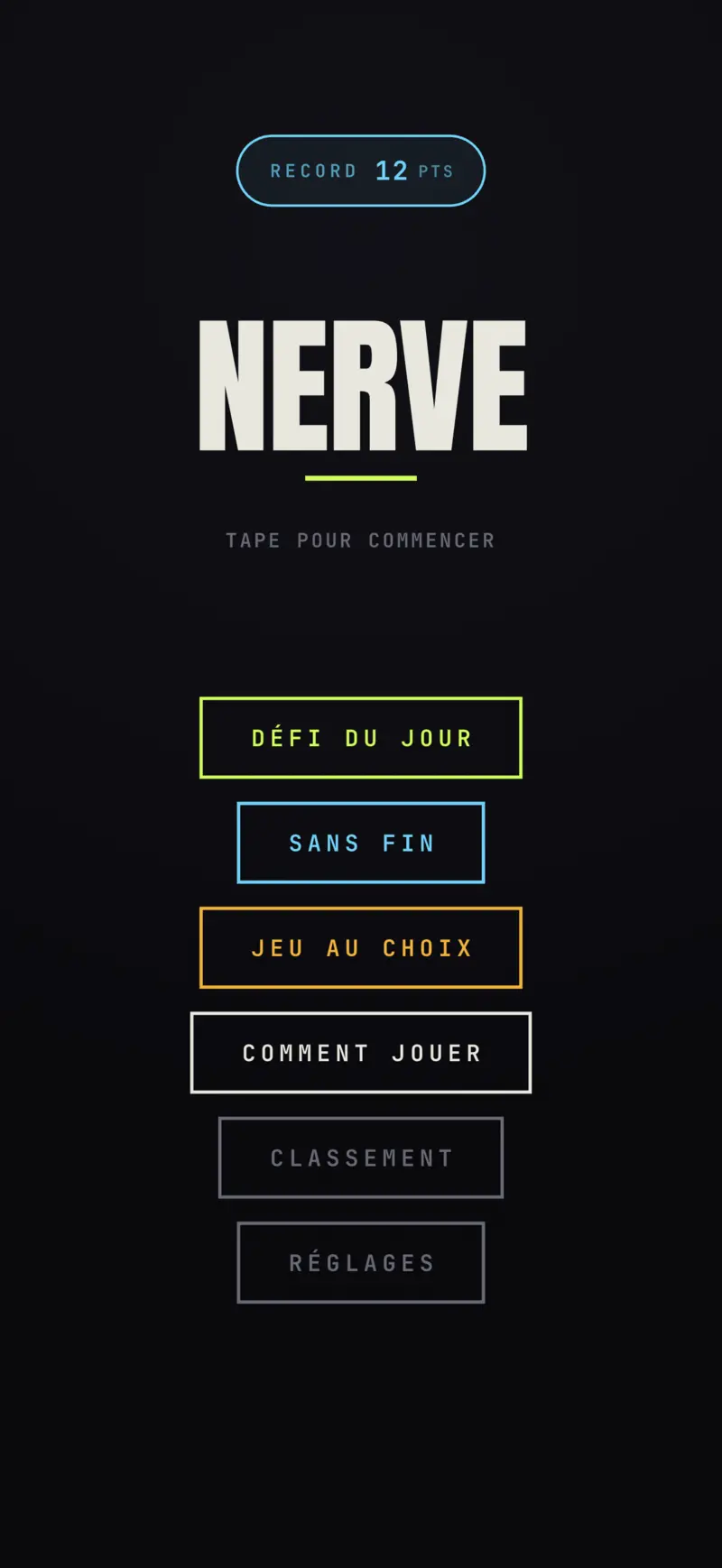
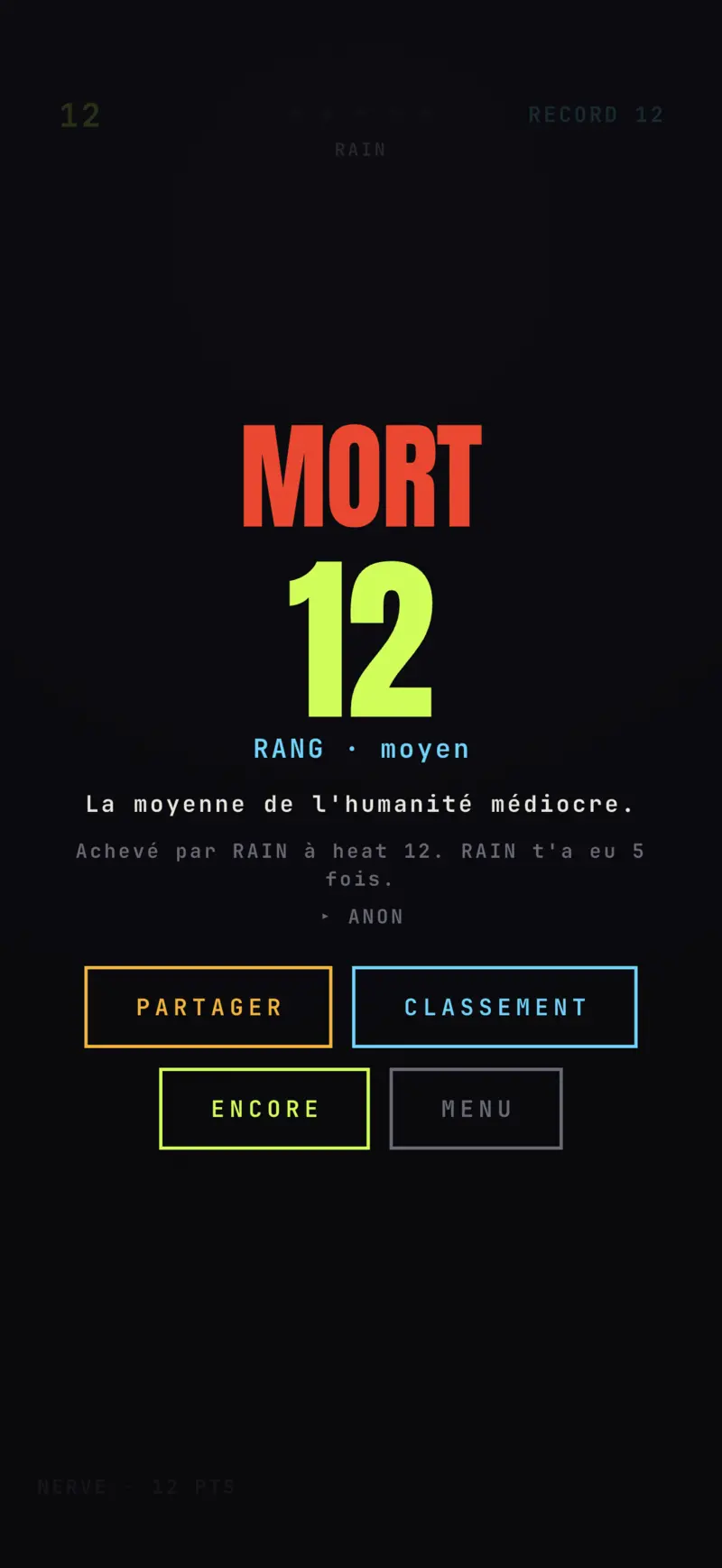
Both, but never alone. Some of the 20 mini-games demand nearly pure detection. Others add a rule, direction, brief memory task, or trap. Then the next game arrives. In Daily and Endless modes, each transition forces you to rebuild the mapping before your finger launches its solo career.
That is the point of a gauntlet: it refuses to keep one response comfortable for long. The global leaderboard therefore rewards more than click latency. You must understand quickly, preserve five shared lives, and stay accurate as difficulty rises. The share card can feed your ego afterwards. Not before.
Keep simple tests as a thermometer. They can tell you whether you are slower than usual. Use choice tasks to train the part that resembles a game: recognize, decide, and suppress the stupid input. Then repeat under the same conditions and see whether the improvement survives several sessions. One personal best is a story. A lower median with the same accuracy is progress.
FAST. BUT CORRECT FIRST.
NERVE chains 20 mini-games, five shared lives, and no time to recite the tutorial in your head.