 NERVE
Goalkeeper reaction time on a penalty: can anyone actually react?
Twelve yards. A ball struck hard. A goalkeeper who has to pick a side before the boot even meets the leather. Goalkeeper reaction time on a penalty is the textbook case of a race you lose before it starts: the human brain needs roughly 250 ms to answer a simple visual signal, and a well-hit penalty can cross the line in 0.2 to 0.3 seconds. Do the maths. Waiting to see where it goes means you already lost.
So the keeper cheats. Not with the rules, with time. He guesses, reads, gambles. And the numbers behind those gambles say a lot about your own reflexes, even if you hold a phone instead of a pair of gloves.
How long does a penalty take to reach the goal?
It depends on who kicks, and on who measures. In their 2007 paper in the Journal of Economic Psychology, Michael Bar-Eli and colleagues use a ballpark of 0.2 to 0.3 seconds from the spot to the line, borrowed from earlier economics work on penalties (Chiappori, Levitt and Groseclose in 2002, Palacios-Huerta in 2003). A Portuguese team that analysed 250 penalties, presented at the European College of Sport Science congress in Oslo in 2009, reports a wider range: 0.4 to 1.2 seconds, because it includes soft and placed shots.
Take the case most generous to the keeper: 0.4 seconds. Subtract the 250 ms of an average visual reaction (the figure you keep meeting when you test your reflexes). That leaves 150 ms for a goalkeeper's body to start moving, leave the ground and cover the 3.66 metres between the middle of the goal and the post. Good luck with that.
And 250 ms is simple reaction time: one signal, one answer known in advance. The keeper also has to choose. Left, right or stay. That is choice reaction time, slower by nature. The same Portuguese group puts the keeper's complex reaction time at 0.7 seconds or more. Against a shot arriving in 0.4 seconds, that does not work. Full stop.
The keeper does not react to the shot. He reacts to what he predicts about the shot.
Why do goalkeepers dive before the kick?
Because they have no alternative. The Bar-Eli et al. dataset covers 286 penalties from top leagues and championships. Keepers went left 49.3% of the time, right 44.4%, and stayed in the centre just 6.3%. The dive matched the direction of the kick in 43% of cases.
43% is not nothing. A keeper picking one of three zones at random would be right one time in three. A keeper who always dived right, the most common target in the sample, would hit 39.2%. So professionals beat chance: they read something, hip angle, run-up, the taker's history. But only just. Most of the time both players commit almost simultaneously, blind to what the other picked.
The taker is no freer. A 2009 study by Bowtell, King and Pain tested the so-called keeper-dependent strategy: start towards one side and switch if the keeper moves. The kicker needs about 0.3 seconds to react and redirect. When the cue arrives 300 to 400 ms before contact, his choices are no better than chance. He only succeeds reliably with more than 500 ms to spare. A keeper who holds his dive until the last moment makes the trick useless. It is a duel of anticipation on both sides, not a reflex contest.
Is staying in the centre the best penalty strategy?
This is the bit that hurts goalkeeper pride. In the same sample, 28.7% of shots went down the middle. When the keeper stayed central he stopped 33.3% of shots, against 14.2% when diving left and 12.6% when diving right. On paper, standing still is the best bet. Almost nobody does it.
Bar-Eli's explanation is psychological: action bias. Conceding while standing still looks lazy. Conceding after a spectacular dive looks unlucky. The regret tastes different. A survey of 32 professional keepers was used to support this idea of a norm to dive. The keeper picks the mistake that shows least.
Except the conclusion has been challenged. In 2009, R. Berger, from the sociology institute of the University of Munich, re-ran the numbers using these data, other published sets and 1,043 Bundesliga penalties. His point: treating a penalty as an isolated decision is the error. If keepers stayed central more often, takers would aim central more often and the edge would vanish. Modelled as a two-player game, keepers behave "astoundingly close" to optimal. Diving almost every time then looks less like a bias and more like a sensible rule of thumb.
Who is right? Probably both, at different scales. On one kick, against a taker who does not know you, the middle is underused. Over a season, against takers studying your clips, it stops being free very quickly.
What penalties reveal about your own reflexes
The penalty kills a popular myth: being fast is not only about low latency. The best keepers are not the ones who react fastest to the ball, since nobody manages that. They are the ones who move at the right time with the best information available. A few lessons transfer well off the pitch:
- When the stimulus is faster than you, anticipation beats reaction. Sprinting wrote it into the rulebook: under 100 ms after the gun, the athlete is assumed to have guessed, hence the 100 ms false start rule.
- Going too early costs as much as going too late. A keeper who dives half a second before the kick hands the taker exactly the margin he needs to switch sides.
- Reading cues is trainable. That 43% hit rate does not fall from the sky: it is information scraped from a run-up of a few steps.
- The best strategy depends on the opponent. What pays against a stranger stops paying against someone who knows your habits.
In short, raw speed sets a floor. Above it, timing wins. We go deeper into this in our piece on reflex vs reaction time, because a keeper, strictly speaking, is doing neither.
And in NERVE?
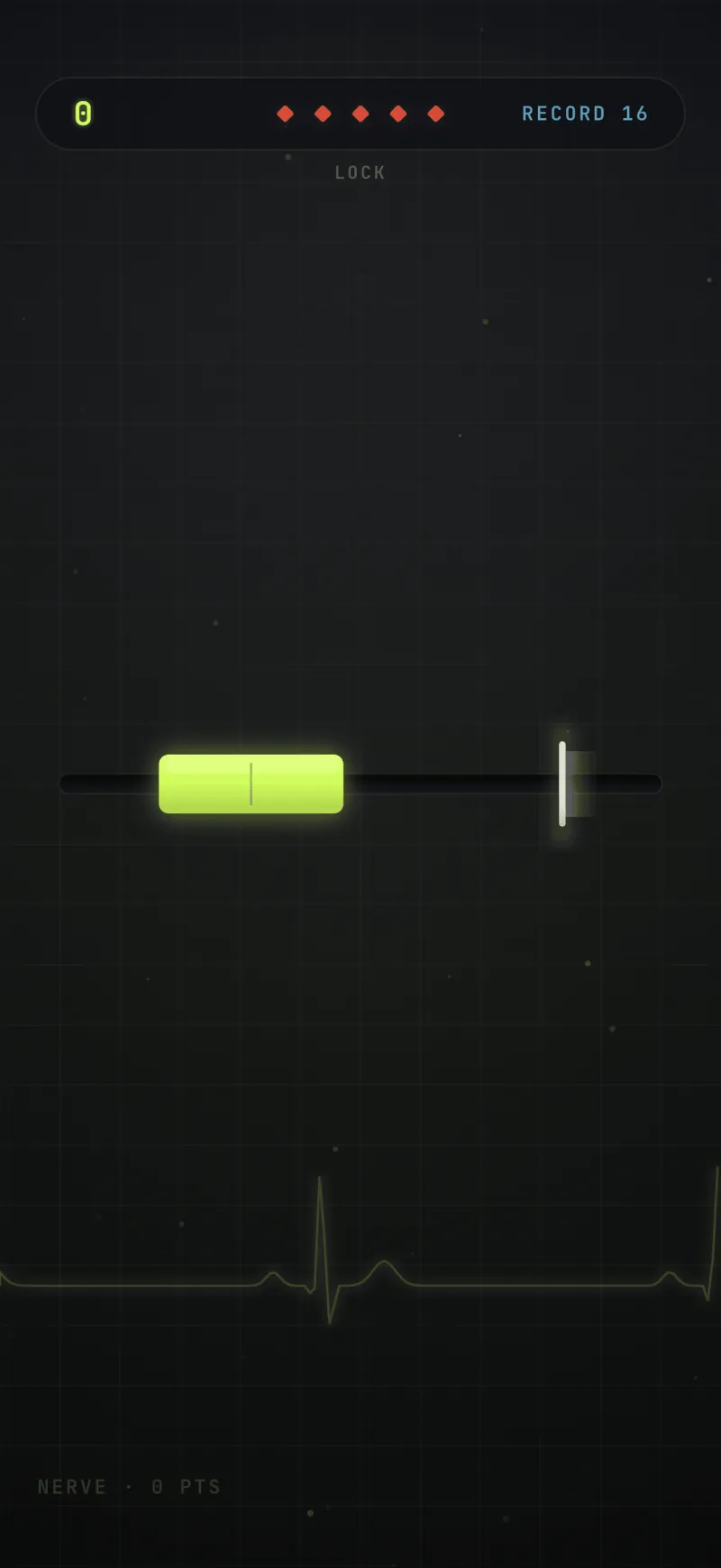
There is no ball in NERVE, but the same time scam is everywhere. In LOCK, a cursor slides along a bar and you have to stop it in the green. Wait until you see it inside the zone before tapping and your thumb arrives after the party. You have to launch the tap while the cursor is still approaching. A keeper's move, touchscreen edition. And just like a penalty, going early is punished as surely as going late.
The 20 mini-games in the gauntlet mix this kind of anticipation with traps where rushing costs you one of five shared lives. In Daily mode everyone faces the same run of the day, which makes the global leaderboard a fairly brutal way to compare who reads timing best. In Endless, it keeps going until your nerves give up.
Next time a keeper dives the wrong way, spare him the sarcasm. He bet before he could see, like everyone does. The real question is how to bet better, and that part can be trained.
BET BEFORE YOU SEE.
NERVE chains 20 mini-games, five shared lives and timings that punish rushing as hard as hesitating.