 NERVE
NERVEThe Stroop effect: why your brain taps red anyway
Look at the word RED printed in green and say the ink colour out loud. You hesitated. Not for long, a few dozen milliseconds, but you did. That little stumble has had a name since 1935: the Stroop effect. Your brain reads the word before you ask it anything, and then you have to slam the brakes on that reading to give the right answer. In a reflex game, that brake costs more than raw speed ever will. People don't lose because they're slow. They lose because they tap the thing they were told not to touch.
So this one is about the other half of reflexes, the half nobody brags about: knowing when not to react.
What is the Stroop effect, exactly?
In 1935, John Ridley Stroop published a set of experiments in the Journal of Experimental Psychology that went on to become one of the most replicated tasks in psychology. The setup fits in a sentence: print colour names in an ink that doesn't match the word, then ask people to name the ink.
The Experiment 2 numbers are right there in the original paper, reprinted by York University. One hundred students. Naming the colour of plain squares took an average of 63.3 seconds per 100 responses. Naming the ink of words that announce a different colour took 110.3 seconds. That's 47 extra seconds, a 74% jump. Same task, same colours, just a word standing in the way.
The reverse barely works. In Experiment 1, reading the word while ignoring the ink slowed the 70 participants by only 2.3 seconds on average, a difference Stroop himself called unreliable. Reading is so automatic in adults that it flattens colour. Colour, on the other hand, was never trained to flatten anything.
Why your brain taps red when you were told not to
The simplest explanation: two processes start at once. A fast, automatic one that reads the word, and a slower one that follows the instruction. When they agree, no problem. When they clash, something has to spot the conflict, park the automatic answer and let the right one through. Neuropsychologists call that job inhibitory control.
Words aren't the only troublemakers. In 1967, J. Richard Simon and A. P. Rudell showed that people respond faster when the side a signal comes from matches the side of the response, even when location has nothing to do with the instruction. A sound in your right ear nudges you toward the right-hand key whether you like it or not. That's the Simon effect, a close cousin of Stroop: useless information, processed anyway, dragging your hand the wrong way.
What these traps have in common is that they don't go after your speed. They go after your selection. You can have a great simple reaction time and still get wrecked the moment a signal lies. We covered the cost of extra decisions in simple vs choice reaction time: every option you add gets billed in milliseconds. Here the bill climbs further, because one of the options is yelling at you.
Go/No-Go and stop-signal tasks: how long does it take to stop?
Researchers have two favourite ways to measure the brake. In a Go/No-Go task, one signal tells you to press, another tells you to do nothing. The trap is frequency: if "go" shows up a lot, pressing becomes a habit and the "no-go" lands on a finger that's already moving. The stop-signal task is nastier: you've already launched your response when a second signal orders you to cancel it.
The time needed to stop an action already under way is called SSRT, for stop-signal reaction time. In healthy adults it's usually estimated at 200 to 250 milliseconds, as a 2020 eLife study on the brain, nerve and muscle cascade behind stopping a movement points out. The authors add a useful caveat: standard ways of calculating SSRT may overestimate it. Keep the ballpark in mind. Stopping takes about as long as starting.
The practical consequence: if the stop signal shows up too long after the go, your thumb is already on its way and nothing will catch it. That isn't a lack of willpower. It's a race between two processes, and whichever finishes first wins. Psychologists literally call it the "race model".
One signal to act, another to hold back. Researchers count the times you act on the forbidden signal.
You've already started the movement and get told to cancel it. Researchers estimate how long braking takes.
How reflex games weaponise the Stroop effect
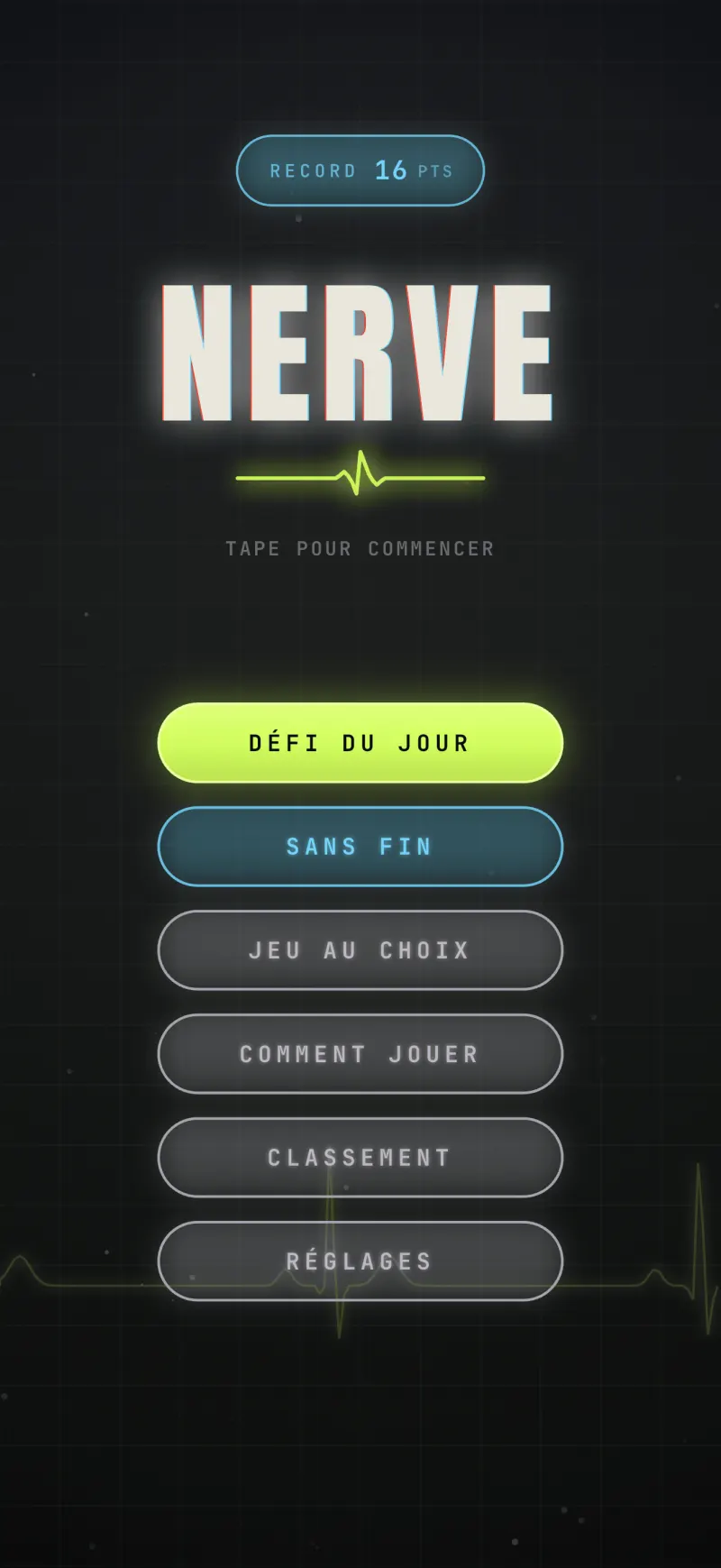
A game that only asks you to be fast gets boring after three rounds. A game that sets traps for you makes you lose your mind. NERVE picked a side. Several of its 20 mini-games are lab tasks in disguise, with a worse attitude:
- SIDE: an arrow points to one side, a word LEFT or RIGHT appears next to it. Follow the arrow, ignore the word. As difficulty rises, the word contradicts the arrow more than half the time. It's Stroop for thumbs, and the fail message doesn't sugar-coat it: "You followed the word. Trapped."
- OBEY: tap on green, never on red. A pure Go/No-Go, on repeat. Tapping red kills you, letting a green slip by kills you too. Stuck between impulsiveness and laziness.
- REACT: wait for green, then tap fast. Further into a run, a very short fake green flash appears during the wait. The finger that jumps on it loses a life, and some dignity.
- STILL: don't move until the countdown ends. The screen shakes and taunts you. Pure inhibition, no movement required.
The cruel part: the 5 lives are shared across the whole gauntlet. Every win makes every game harder, and a fail throws you into another mini-game without warning. So you go from a game where you must tap as fast as possible to one where you absolutely must not tap. Your brain keeps the old rule loaded a fraction of a second too long. That's where the machine gets you.
Can you train inhibitory control?
Honest answer: you mostly get better at the task you practise. Play SIDE a lot and you'll get better at SIDE. You'll learn where to look, when the word lies, how to keep the arrow in mind. Whether that carries over to your life, your driving or your resistance to a packet of biscuits is another story. Research on inhibitory control training tends to find modest effects, often limited to the trained task or to the short term. Be suspicious of anyone promising otherwise with an app.
What does work on screen is pretty concrete:
- read the instruction before you move, even when the game rushes you: half a second of reading costs less than a life;
- lock onto the right cue and only that one, the arrow in SIDE, the colour in OBEY, and let the word blur;
- don't keep your finger hovering on the glass during waiting phases, it cuts down on jumped starts;
- play rested, because fatigue hits braking tasks first. Our piece on sleep deprivation and reaction time spells out the price of a short night.
Above all, stop judging your reflexes by your stopwatch alone. A player who reacts in 220 ms but hits the wrong signal one time in five loses to a 260 ms player who never slips. To see where you really stand, test your reflexes with a method that doesn't cheat, and look at your mistakes, not just your average.
What the Stroop effect says about you
Nothing very flattering, which is reassuring. If you read the word instead of the colour, your reading is fully automatic, like nearly every adult's. The day you feel zero hesitation in front of RED printed in green, see someone. Or stop reading.
The real skill, in a reflex game and outside it, isn't reacting to everything faster than everyone else. It's reacting only to what matters. The rest is noise, and the machine loves noise.
THE WORD LIES. THE ARROW DOESN'T.
20 mini-games, several of them traps for twitchy fingers, 5 shared lives, a daily challenge, an endless mode and a global leaderboard. The machine counts your mistakes.